The origin of humans is most certainly one of the most contentious points of evolutionary theory. Many people who believe in the God of the Bible accept that evolution created the animals but they still believe that humans (or at least their souls) were created by God. Such compromise positions have ultimately undermined the authority of God’s Word; Scripture is accepted for its moral value but not for its absolute truth in every area. It would seem that almost every culture on the planet has some story to explain how humans came to be. Many of these involve supernatural acts by gods. Naturalistic science, by its own definition, does not accept these supernatural events and regards them as myth. Religion and mythology are often viewed as some evolved coping mechanism to explain things that our brains have not been able to understand or directly experience. The scientific community must reject a supernatural origin based on its naturalistic/materialistic definition of science.
One of the reasons that human evolution is such a hot issue in Western culture stems from the direct conflict it has with biblical Christianity. In the creation account of Genesis 1 and 2, man is created in a position above the animals—in the very “image of God.” In evolutionary philosophy, man is a mere accident in the experiment run by time, chance, and natural laws. Man occupies no more important a position in the universe than does an asteroid floating through space. This notion runs contrary to the emotions of most people, but that may simply be arrogance due to our highly evolved brains.
Many may believe that there is a wide array of fossil evidence that clearly shows how apes have become humans. The iconic depiction of a hunched monkey gradually developing into an uprightwalking human has been viewed by most people. The problem is that much of the visuals are made up. The absence of a consistent story of evolution is obvious in the way that human ancestry is presented in the textbooks. Instead of showing a phylogenetic tree, two of the textbooks (Holt and Prentice Hall) simply show timelines representing the fossils. The Glencoe text shows a “possible” phylogenetic tree with many dashed lines (which are assumed to be questionable, even though they are not indicated as such), and one line appearing out of thin air. The cautious treatment of this topic shows the lack of consensus within the scientific community regarding the alleged ancestry of humans.
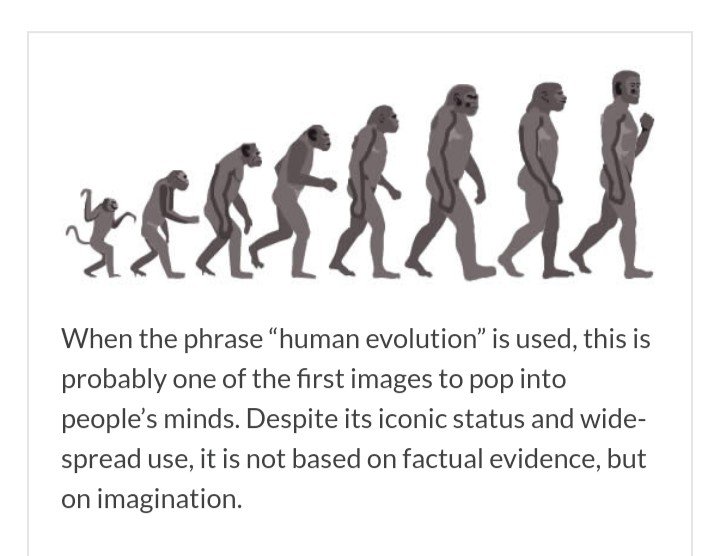
The proposed evolutionary ancestors to humans have changed many times over the decades as new fossil evidence has been gathered. While it is not expected that theories should remain constant, the picture seems to become less and less common with the addition of new information. Many nearly identical terms are used to describe alleged human and ape ancestors. Care must be taken to distinguish between hominoids, humanoids, hominins, hominans, and hominids. The most commonly discussed term is “hominid”:
Hominid: extinct and living members of the family Hominidae, including modern humans and their ancestors.
The term hominid has a somewhat contradictory definition within and between the textbooks reviewed. Different classification schemes place the orangutans, gorillas, and chimps (these three are commonly called the “great apes”) in the family Pongidae, while other schemes place these three in the family Hominidae with humans. Depending on which scheme is used for classification, the meaning of the word changes. Whether the term includes the great apes is somewhat irrelevant in that all groups still share a supposed common ancestor. In the broader scope, all four of these groups would be referred to as hominoids. The textbooks seem to indicate that only bipedal (walking upright on two legs) primates are classified as hominids, and the figures discussing hominids include “ancestors” that are assumed to be bipedal (Homo, Australopithecus, Ardipithecus, etc.). A review of current literature seems to indicate a trend toward including all four groups in the family Hominidae, which would mean the definition would need to be modified. The term has no value in the creationist model because there are no human ancestors—apes are apes, humans are humans. This does not mean that all creationists agree on the classification of all of the fossil primates. Classification is a subjective issue, especially when dealing in the historical realm of fossils and fragments of fossils. It is important to recognize the limits of accuracy when dealing with such a topic.
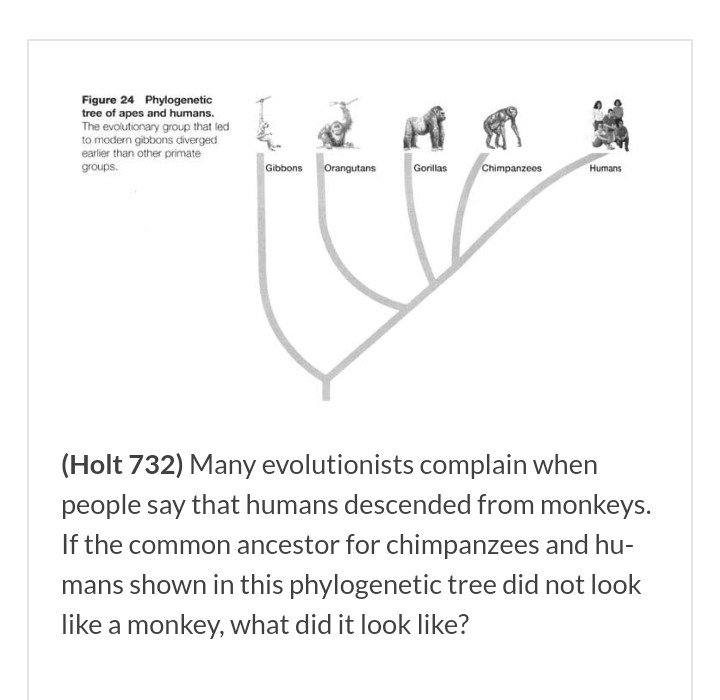
Many evolutionists try to dispel the popular idea that humans evolved from monkeys. While that statement is a simplification of human evolution, evolutionists claim that there is a common ancestor for monkeys, apes, and humans. If this common ancestor didn’t look something like a monkey, what did it look like? It would be more accurate to say that humans, monkeys, and apes have a common ancestor, but the distinction is relatively minor when considering that the ancestor of all apes and monkeys must have looked something like an ape or monkey.
The moral implications of the evolutionary philosophy that man is simply an advanced ape are increasingly manifested in our culture. If man is an ape, then the apelike or “primal” urges that we have for violence and sexuality can be excused as coming from our evolutionary history. Exercising those urges is contrary to the Christian doctrine of self-control. Many evolutionists try to separate biological evolution from evolutionary-based social philosophies on the grounds that those philosophies are not scientific. While this is true, evolutionists still try to deal with questions of behavior and their origins.
Bioethics is the area that deals with the moral and ethical implications of scientific knowledge and the technology it produces. If society espouses evolutionary/materialistic beliefs, those beliefs have consequences. There is no absolute basis for morality in a materialistic belief system; right and wrong are determined by the individual and society. As society changes, the laws that govern a society also change. Accepting the view that humans are simply highly evolved apes and that man determines truth is directly contrary to the absolute authority of the Creator God of the Bible.
Starting from the evolutionary bias that apes and humans are similar, some evolutionists have proposed that chimps should actually be reclassified in the genus Homo alongside humans. Taking this a step further, several groups are pushing for “human rights” for the apes. If they are truly that similar to us, why not grant them these rights? One reason is that the Bible makes a clear distinction between human life and the life of animals. We are to be stewards of the earth and have dominion over the animals, but we are created in the image of God, which makes us distinct from the apes
Piltdown man was thought to be a missing link for over 50 years before it was discovered to be a fraudulent combination of a human skull and an orangutan jaw. But because people wanted to believe evolution, they initially accepted the evidence without scientific scrutiny. The many different and dubious interpretations of Java man and Peking man (well documented in Bones of Contention by Martin Lubenow) are further evidence that people see what they believe in the fossils. Nebraska man was a hallmark in the Scopes Trial, but the tooth that inspired this image was later determined to be from an extinct pig.
There is no need to look for missing links if man is classified as a monkey, as a 1993 display at the Australian National Museum depicted: the common behaviors in humans and various apes were set forward as evidence for the claim. Australopithecus, the genus of the infamous “Lucy” specimen, is one of the most cited examples of a missing link in human evolution. The problem is that australopithecine features are all apelike, despite the claim that they walked upright. Many depictions actually show human hands and feet when the evidence clearly indicates curved, apelike features.
The fact that tools are found with some
 hitsupdate.com